
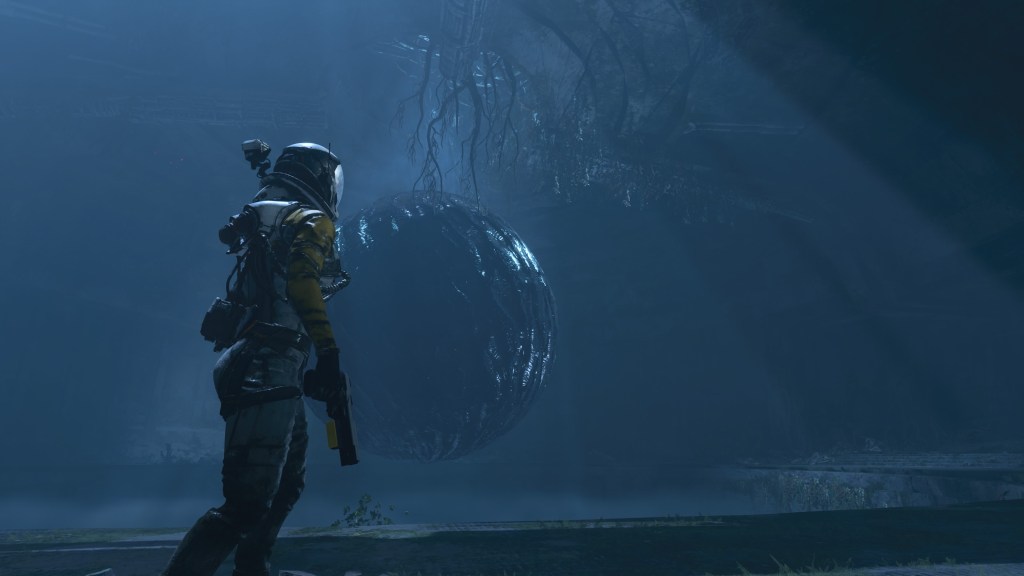


Having caved and bought myself a PS5 last summer when it went on a decent enough sale for me to bite the bullet, I finally got the opportunity to play the one console exclusive game that had intrigued me the most. Housemarque’s Returnal is in line with their prior works, with a heavy emphasis on crafting an arcadey bullet hell shooter with snappy and precise movement and mechanics. I already was a fan of them after having played their brilliantly fun Resogun and Matterfall, which were rather simplistic in comparison. Because they really managed to kick it up a notch or three with their latest entry.
Before I dive into why Returnal’s gameplay loop is so brilliant in my mind, some quick introductory words on the game for the uninitiated. Returnal is a roguelite third-person bullet hell shooter with a focus on high mobility and precision. As Selene, you find yourself crash-landed on an alien planet, with nothing on you but your trusty handgun. And of course, you are not alone there. As you attempt to make your way to a potential escape route, you quickly learn that this world is brutally hostile, and just swarming with nasties in various shapes and forms making your life miserable along the way. Before eventually putting an end to it.
Or so you would think. Every time Selene dies, she finds herself back at the crashsite, with memories of her prior experiences largely in tact. The world around her changes with each subsequent death, making it even more difficult to find her way forward. And while she gets to keep some permanent upgrades she picked up along the way in regular roguelite fashion to help make the next attempt a little bit easier, some other hard earned things end up being lost forever. Some of the permanent upgrades include different abilities to help you reach new places in familiar areas, adding a bit of a metroidvania flavour to the mix, and you pretty much exclusively gain those from defeating area bosses for the first time. Others let you unlock different kinds of weapons that get added to the pool in subsequent runs, or different attributes for those weapons that let you change up your playstyle to keep things fresh and interesting. All in all a pretty standard roguelite affair.
One more aspect I want to highlight before I dive a bit deeper into the gameplay loop is the moment to moment gameplay itself. As I already mentioned, the overall game feel is very arcadey. It is very fast-paced and aims to keep you on your toes at all times. Selene has plenty of mobility options, which she desperately needs because you are pretty much dead the moment you stop moving. As such, running and evasive dashes come without stamina cost, and alongside jumping and strafing they are the only tools at your disposal to help you navigate the intense bullet hell you are put up against. Other than different kinds of guns, you also have a sword at your disposal, and learning how to use it well is elemental to your chances of success. It does some beefy damage and can destroy shields, but both the windup and cooldown animations are rather lengthy. Coupled with the fact that you have to get up-close and personal to take advantage of it, it puts you in a high risk, high reward position, which I always enjoy seeing in video games.
That should be enough to give you an impression of the moment to moment gameplay, so it is time to dive into the loop itself, because there are two different sides to it. And therein lies the beauty of Returnal in my opinion.
Your first gameplay loop is the meat and potatoes of the game. Making your way from the crashsite through the opening biome, you pick up some valuable upgrades along the road, both permanent and temporary. You stumble upon log entries earlier iterations of Selene have recorded themselves, with each one adding another piece to an increasingly convoluted puzzle. And if you persevere, you will find your way to the next biome being blocked by a boss. Defeat it to reach the next biome, where the loop continues. You only have to beat those bosses a single time, and while you can re-attempt them on subsequent runs for a chance at getting some valuable loot, you are also free to simply circumvent them and make your way straight to the next biome. The layouts of the biomes are procedurally generated, providing you with a clean slate after each death.
Naturally, there is a lot at stake in this primary gameplay loop. Such is the design philosophy of a roguelite, after all. The farther you push yourself, the more the pressure to succeed and the anxiousness to fail starts to build up. You are having such a good run, after all. Everything went swimmingly. Would be a shame if you got unlucky with a room full of just the kind of elite enemies you are ill-equipped to deal with thanks to your current loadout, all while being low on health and out of restoratives. And of course, eventually something will put an end to your run, be it a poorly timed difficult encounter, or the culmination of some poor choices you made along the way. It is inevitable, after all. And it absolutely stings after you have put a lot of time into a run that looked promising, only to then fall apart in a matter of minutes.
This is standard for any rougelite, of course. I can not claim to have the most extensive history with the genre, with Hades, Dead Cells, and Slay the Spire being the only ones I ever really managed to get into, and with Balatro being on my list to attempt to get into next. The thing that elevated Returnal for me is the fact that the core gameplay loop is being supplemented by a secondary one. Back in 2022, Returnal recieved the Ascension update, introducing the option to brave the unknown in co-op, but also adding the Tower of Sisyphus. It is the Tower of Sisyphus itself that offers an extra gameplay loop. The beauty of it is that it provides a distraction from the high-stakes campaign, while also being woven into the main event, and both of them are best experienced in tandem.
Imagine getting frustrated after losing a run in a way that makes you mumble “Bullshit!” at the TV screen and pull out your phone to put Limp Bizkit on blast. In other rougelites, the only way to really cope with this is to close the game and go do something else for a while to recharge your batteries. In Returnal, you can hop into the Tower of Sisyphus to unload all the pent-up frustration. At its core, the Tower is a side-mode that lets you ascend floor after floor of encounters without anything at stake but your own pride and a high-score. You can unlock some story segments here along the way, and they tie into the main campaign perfectly; but the real benefit of this mode is that it offers you a zero-stakes way to get familiar with and practice with different weapons and attributes against different types of enemies, and allows you to unwind after all the intense pressure of the primary gameplay loop.
Once I had unlocked the Tower, I found myself getting into a loop of alternating between it and the main campaign, which vastly improved my overall enjoyment of the game. Before that, the only option to unwind with relatively low stakes were the daily runs that pitted you against a specific biome with a predetermined loadout and some modifiers to make things a bit more interesting. The Tower, however, is what made the experience more approachable for me. It is a genius inclusion, and I wish more roguelites offered a similar side activity to de-stress, all while giving you the opportunity to grow in your understanding of the game’s mechanics at the same time.
A lot more could be discussed regarding this game. Another intriguing aspect to me is that it is absolutely loaded with risk-reward choices, and I do intend to get into that at some point as well. But I wanted to keep things reasonably brief with this one for the time being. If one day I actually manage to beat the game, I am sure to revisit it to discuss it in more detail.

 quiche.cafe
Leave a comment